Tuesday, November 24, 2009


Monday, November 16, 2009
Dynamic Duo
I was recently playing guitar with my friend Aaron Schwarz and we wound up having quite a lengthy discussion about the importance of dynamics and accents in making music beautiful. Open any score dated from the 18th century onward, and we find dynamic markings, slurs and accents amongst other things which help us understand that performance is so much more than just playing notes, and also what the composer’s vision of how all these various other factors should be handled.
Two interesting articles on the subject include http://www.kylegann.com/notation.html, which talks about the dangers of over notation, as well as http://thebadplus.typepad.com/dothemath/2009/09/interview-with-keith-jarrett.html, an interview where Keith Jarrett talks a lot about touch, about a lack of sensitivity amongst jazz pianists and I would like to extend his point to many jazz guitarists.
Horn players spend their formative years learning proper technique and reading music with a focus on how to play and phrase and feel it accurately. Most guitarists probably learned music other than jazz and in some combination of reading magazines or books and piecing things together by ear. When we are introduced to jazz, we are presented with lead sheets, sparse papers with little information on them other than the most essential to get a musician started on the process of interpretation. It is still necessary to listen to performances of the song, understand all the harmonic nuance that every good jazz musician brings to a tune, that the changes as they are written are a starting point and should never be considered a destination and that any good group contains both a rhythm section and soloists who are open and flexible enough to go places other than the typical. Back to the point, guitarists encounter a written form of jazz which does very little justice to the actual performance of jazz. There is so much nuance in any good jazz musician’s tone and use of dynamics, their touch on their instrument, and yet so little time is devoted to developing this consciously with students of jazz. You got it or not, I suppose. Actually, I don’t suppose that at all.
When I started taking guitar lessons formally in school, my wonderful teacher Nick Ditomaso never failed to amaze me week after week. It seemed like there were a million things he knew how to do and I just didn’t have a clue what any of them where. This changed about halfway through our association. Over a year and a half I’d worked furiously to learn all the scales and how to improvise and comp using drop 2 chords and a generally more melodic approach to rhythm playing. As my second year came to a close, I’d succeeded in doing this to some degree. I’d even figured out a couple of voicings that seemed to be all mine. But I still didn’t sound half as good as Nick did.
Now I began to become truly awestruck in a much deeper sense by Nick’s sound. I couldn’t understand how he sounded so amazing and I didn’t. When I watched his hand move, I could finally recognized the voicings and patterns. I’d learned a decent chunk of the standard jazz vocabulary on my instrument (in terms of scales and voicings), and like any other guitarist playing standards, Nick was often referring to this vocabulary in his playing in ways that I could comprehend. But still his sound was lightyears ahead of mine and I didn’t really get why.
Over the next year and a half, I began to bridge the gap in our sounds but never consciously and only very minutely. Nick always told me to work more on my tone but I always felt like what he was really asking me to do was buy a new guitar and that wasn’t going to happen. I wasn’t ready to understand what I was missing because I was still too focused on vocabulary. I was fascinated with the idea of altering chords, of playing outside, using chromatic passages, learning tunes and finding voicings which allowed me to play the harmony and melody at the same time. I loved Lenny Breau and Ted Greene but no matter what chords I learned I could never even begin to approach their sound. As I got my hands on all the material I could about them and by them, I was again, much like with Nick, chronically disappointed by the lack of a secret chord or two which would let me sound like them.
Then I met Mick Goodrick. Mick talked very little about touch. But he played in front of me every day for five days and in just sitting and listening to him over the course of a week it hit me. Watching him play, hearing him attack, hearing his careful attention to dynamics and his quiet authority had a big influence on me. When I met him for my lesson I was determined not to try to impress him by overplaying. How many people walk into a room with Mick Goodrick and whip out their best licks in the first chorus of their first solo and accomplish nothing musically and tell no story whatsoever? We played Stella By Starlight and I came in very quietly and delicately. I tried to be melodic, didn’t worry about conveying to Mick that I knew the changes and could play over them. I wanted to build something because I thought that would be more impressive and so accordingly I wasn’t in a rush. Along came my second chorus and I started to lay into the notes a bit more. This is the first time in my life playing jazz that I can remember where I consciously used dynamics as a major factor in the building of my solo. But I went too far too fast. It was too loud for Mick. I’d spoiled our sound with a lack of sensitivity and he stopped me and told me so.
The same day I played a free jazz piece with 3 other guitarists, and 2 very talented and wise musicians named Vardan Ovsepian on piano and Bob Weiner on drums. Minutes into the piece, it still felt like it wasn’t building to me, like the other guitarists were holding back too much or too scared to play with commitment so I took it, quite arrogantly and mistakenly, upon myself to push things in a certain direction. Quite naturally, I once again got very loud very fast. What resulted wasn’t so bad, but it was basically musical premature ejaculation. Things boiled up very fast and cooled off almost instantly after hitting a peak. It was a noisy experience. And I experienced a sensation of extreme heat while playing which left me overwhelmed and flustered and actually drove me to tears a bit later in the day.
To say I came home and went wild about dynamics would be a lie. My first blog entry was a summary of everything I’d taken away from my week with the Mr. Goodchord team and there is no mention of dynamics in that article, nor did I mention either of those very important stories. I was overwhelmed by these events and I wasn’t ready to face them yet. But they were a part of me and they were guiding me. I was scarred and quite unconsciously the way I heard myself began to evolve. When I finally recorded myself almost 5 months later (you can hear that recording of Stella on MySpace), I was pleased to finally hear what I’d been searching for without knowing it for four years: dynamic nuance. Even my most stock phrases, things I’d been playing for most of those four years, suddenly were popping out at me. They had become three dimensional. My foot was in the door.
Can we work on these things consciously? Can we build exercises to help us develop the physical skill of having many different and interchangeable levels of attack?
Here are a few:
Take any ii-V lick and try playing it at a single tempo and see how many different volume levels you can achieve. Try this at different tempos and see which volumes are difficult. The faster you get, the more obviously hard it becomes to play quietly.
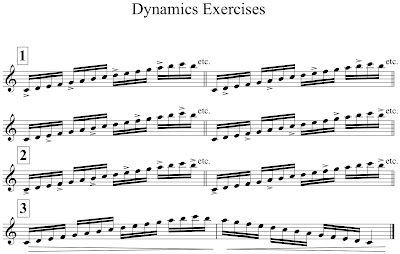
Another thing to do is to play a scale up and down at various tempos, placing the accent on a different 16th note every time (1). Also, this can be done with 3 and 5 which displaces the accent (2).
Also, as we get higher we have a tendency to get louder and play harder and there’s something inherently more relaxing and gravitational about playing a descending scale. So try playing a scale getting quieter going up and louder going down (3).
This conversation does not only apply to playing single notes with a pick. Using your fingers to play chord solo types of sounds is infinitely more effective in terms of dynamics as well. I think my studies are actually very good for this exercise. If you see the videos, you’ll notice that I arpeggiate the chords, perhaps add in melodic embellishments, but that none of this was notated. Playing the studies is firstly a very note oriented exercise in learning new and wider voicings. But unconsciously, I was also working on popping out the melody from the overall texture of the rest of the chord, by creating dynamic contrast between the most important note at any given time and all the others (it's hard to tell since the audio quality is so garbage). These studies are good for that because the wide voicings tend to make the melody notes sound more isolated, which can help you start to hear things differently. I think they did that for me.
Two interesting articles on the subject include http://www.kylegann.com/notation.html, which talks about the dangers of over notation, as well as http://thebadplus.typepad.com/dothemath/2009/09/interview-with-keith-jarrett.html, an interview where Keith Jarrett talks a lot about touch, about a lack of sensitivity amongst jazz pianists and I would like to extend his point to many jazz guitarists.
Horn players spend their formative years learning proper technique and reading music with a focus on how to play and phrase and feel it accurately. Most guitarists probably learned music other than jazz and in some combination of reading magazines or books and piecing things together by ear. When we are introduced to jazz, we are presented with lead sheets, sparse papers with little information on them other than the most essential to get a musician started on the process of interpretation. It is still necessary to listen to performances of the song, understand all the harmonic nuance that every good jazz musician brings to a tune, that the changes as they are written are a starting point and should never be considered a destination and that any good group contains both a rhythm section and soloists who are open and flexible enough to go places other than the typical. Back to the point, guitarists encounter a written form of jazz which does very little justice to the actual performance of jazz. There is so much nuance in any good jazz musician’s tone and use of dynamics, their touch on their instrument, and yet so little time is devoted to developing this consciously with students of jazz. You got it or not, I suppose. Actually, I don’t suppose that at all.
When I started taking guitar lessons formally in school, my wonderful teacher Nick Ditomaso never failed to amaze me week after week. It seemed like there were a million things he knew how to do and I just didn’t have a clue what any of them where. This changed about halfway through our association. Over a year and a half I’d worked furiously to learn all the scales and how to improvise and comp using drop 2 chords and a generally more melodic approach to rhythm playing. As my second year came to a close, I’d succeeded in doing this to some degree. I’d even figured out a couple of voicings that seemed to be all mine. But I still didn’t sound half as good as Nick did.
Now I began to become truly awestruck in a much deeper sense by Nick’s sound. I couldn’t understand how he sounded so amazing and I didn’t. When I watched his hand move, I could finally recognized the voicings and patterns. I’d learned a decent chunk of the standard jazz vocabulary on my instrument (in terms of scales and voicings), and like any other guitarist playing standards, Nick was often referring to this vocabulary in his playing in ways that I could comprehend. But still his sound was lightyears ahead of mine and I didn’t really get why.
Over the next year and a half, I began to bridge the gap in our sounds but never consciously and only very minutely. Nick always told me to work more on my tone but I always felt like what he was really asking me to do was buy a new guitar and that wasn’t going to happen. I wasn’t ready to understand what I was missing because I was still too focused on vocabulary. I was fascinated with the idea of altering chords, of playing outside, using chromatic passages, learning tunes and finding voicings which allowed me to play the harmony and melody at the same time. I loved Lenny Breau and Ted Greene but no matter what chords I learned I could never even begin to approach their sound. As I got my hands on all the material I could about them and by them, I was again, much like with Nick, chronically disappointed by the lack of a secret chord or two which would let me sound like them.
Then I met Mick Goodrick. Mick talked very little about touch. But he played in front of me every day for five days and in just sitting and listening to him over the course of a week it hit me. Watching him play, hearing him attack, hearing his careful attention to dynamics and his quiet authority had a big influence on me. When I met him for my lesson I was determined not to try to impress him by overplaying. How many people walk into a room with Mick Goodrick and whip out their best licks in the first chorus of their first solo and accomplish nothing musically and tell no story whatsoever? We played Stella By Starlight and I came in very quietly and delicately. I tried to be melodic, didn’t worry about conveying to Mick that I knew the changes and could play over them. I wanted to build something because I thought that would be more impressive and so accordingly I wasn’t in a rush. Along came my second chorus and I started to lay into the notes a bit more. This is the first time in my life playing jazz that I can remember where I consciously used dynamics as a major factor in the building of my solo. But I went too far too fast. It was too loud for Mick. I’d spoiled our sound with a lack of sensitivity and he stopped me and told me so.
The same day I played a free jazz piece with 3 other guitarists, and 2 very talented and wise musicians named Vardan Ovsepian on piano and Bob Weiner on drums. Minutes into the piece, it still felt like it wasn’t building to me, like the other guitarists were holding back too much or too scared to play with commitment so I took it, quite arrogantly and mistakenly, upon myself to push things in a certain direction. Quite naturally, I once again got very loud very fast. What resulted wasn’t so bad, but it was basically musical premature ejaculation. Things boiled up very fast and cooled off almost instantly after hitting a peak. It was a noisy experience. And I experienced a sensation of extreme heat while playing which left me overwhelmed and flustered and actually drove me to tears a bit later in the day.
To say I came home and went wild about dynamics would be a lie. My first blog entry was a summary of everything I’d taken away from my week with the Mr. Goodchord team and there is no mention of dynamics in that article, nor did I mention either of those very important stories. I was overwhelmed by these events and I wasn’t ready to face them yet. But they were a part of me and they were guiding me. I was scarred and quite unconsciously the way I heard myself began to evolve. When I finally recorded myself almost 5 months later (you can hear that recording of Stella on MySpace), I was pleased to finally hear what I’d been searching for without knowing it for four years: dynamic nuance. Even my most stock phrases, things I’d been playing for most of those four years, suddenly were popping out at me. They had become three dimensional. My foot was in the door.
Can we work on these things consciously? Can we build exercises to help us develop the physical skill of having many different and interchangeable levels of attack?
Here are a few:
Take any ii-V lick and try playing it at a single tempo and see how many different volume levels you can achieve. Try this at different tempos and see which volumes are difficult. The faster you get, the more obviously hard it becomes to play quietly.
Another thing to do is to play a scale up and down at various tempos, placing the accent on a different 16th note every time (1). Also, this can be done with 3 and 5 which displaces the accent (2).
Also, as we get higher we have a tendency to get louder and play harder and there’s something inherently more relaxing and gravitational about playing a descending scale. So try playing a scale getting quieter going up and louder going down (3).

This conversation does not only apply to playing single notes with a pick. Using your fingers to play chord solo types of sounds is infinitely more effective in terms of dynamics as well. I think my studies are actually very good for this exercise. If you see the videos, you’ll notice that I arpeggiate the chords, perhaps add in melodic embellishments, but that none of this was notated. Playing the studies is firstly a very note oriented exercise in learning new and wider voicings. But unconsciously, I was also working on popping out the melody from the overall texture of the rest of the chord, by creating dynamic contrast between the most important note at any given time and all the others (it's hard to tell since the audio quality is so garbage). These studies are good for that because the wide voicings tend to make the melody notes sound more isolated, which can help you start to hear things differently. I think they did that for me.
Sunday, November 15, 2009
The Beethoven Blessing
If you ask most people to choose between having to be deaf or blind they quickly choose deafness. Since my ears are my most important and only constant instrument regardless of what kind of music I am doing, I quickly choose to go blind rather than lose such a critical tool for my art.
Beethoven started going deaf around the age of 30. In his wikipedia article it states that “Over time, his hearing loss became profound: there is a well-attested story that, at the end of the premiere of his Ninth Symphony, he had to be turned around to see the tumultuous applause of the audience; hearing nothing, he began to weep.” Beethoven’s last and unsuccessful attempt at performing his own work was in 1811, sixteen years before his death. So how did a man so profoundly deaf continue to compose new and influential pieces of music for 16 years, especially his ninth symphony and and the late string quartets?
Well, go back to his very first string quartets and you’ll find the exact same harmonic language. In fact, check out his symphonies or piano sonatas, everywhere the same chords follow the same sequences. So what was on Beethoven’s mind?
I would like to hypothesize: everything else. Notes are the most insignificant aspect of music. You either follow the principles and standards of a style or not, and therefore sound one way or another. This takes time to understand and be able to employ, certainly if you have an interest in numerous styles all with different aesthetic principles (or lack thereof) as well as general attitudes and emotional demands. Although it may take years to reach an adequate level of proficiency in simply being able to use the musical vocabulary of a style accurately, this is the first and least important step in the process of making beautiful music.
Once you’ve got your notes in order, it’s time to move on to all the other aspects of composition and improvisation such as dynamics, phrasing, form, motivic relations, etc. that make great music what it is.
So how did Beethoven’s music evolve over his career? Well, I recently read quite a few chunks of a book called “Inside Beethoven's quartets: history, interpretation, performance” by Lewis Lockwood and the Juilliard String Quartet. It helped me understand what was so amazing about Beethoven as well as how he became increasingly sophisticated over time. It had nothing to do with harmonic inventions. Beethoven was an architect. How bits of musical information interacted, how he played with form and structure, with dynamics and pacing, was what made him a master.
So why blessing? Well, for starters, check out Christos Hatzis’ essay called “The Crucible of Contemporary Music.” One thing he talks about is that when we start out as artists, we are, in all honestly, just following an egotistical desire for attention and affection. Over time, if you’re lucky, this urge to create can grow into something more mature, more mystical, and less self-centered.
So why the Beethoven Blessing? Beethoven understood better than any other composer had until that time that we would turn him into something he wasn’t: a caricature and a god. He was the first composer to take very seriously the idea that he was writing music for people who he would never meet, perhaps for off into the future. When people reacted negatively to his middle or late quartets, he responded that they were written for the future, for others who would be able to understand them better (I’d love to be more specific but I returned the book over a month ago and don’t feel like doing the research, but this fact is based on an anecdote told by Lewis Lockwood who is a serious Beethoven scholar). Beethoven had an ego. A big ego. You need one to do what he did. You have to believe yourself capable of great things before you stand a chance at doing them. It’s a struggle not to let that get to your head.
Although Beethoven’s deafness brought him great suffering and made him suicidal, in a way it was a blessing because it forced him to limit his artistic vision to a very specific set of criteria. If he had never gone deaf he might have simply tried to do too much, even with all his colossal talent. If he had never gone deaf, we would never have all the beautiful works that he could not have written unless he had gone deaf. And he might have spent too much time anticipating much of the harmonic innovations which would be developed over the following century and as a result not succeeded in being the pinnacle of structural genius of Western music.
Furthermore, Beethoven’s deafness is a blessing to the rest of us, because it teaches us how much goes into the art of composition and interpretation that is completely outside the mere selection of notes.
One afterthought while we’re on Beethoven, a post-script so to speak, is that I don’t agree with the notion of writing for the future. Music is about connecting to an audience. A live audience. Not necessarily a large audience. Not even necessarily an audience at all, just the simple sharing of music amongst musicians creating a moment together is a beautiful thing. Compositional tools which have no impact on a listener are completely unnecessary from the perspective of creating for an audience. That isn’t to say they must be completely abandoned. If they don’t detract from the piece of music emotionally at all, and they bring the composer satisfaction, no harm done. But if the composer’s intellectual satisfaction comes at the expense of the listener’s emotional satisfaction, than in a very real way the composition is a failure. I bring this up because, sometimes Beethoven is simply too long for me. I was surprised to find after listening to the quartet Op. 130 that not only was it extremely long, but it was long even though the Alban Berg quartet had actually left out many repeats in their performance. Of course, if a piece is written for musicians to perform simply for their own enjoyment in private, then the composer has met the goal of satisfying his audience and has succeeded even if most people won’t like it. Still it’s funny how so many jazz musician’s and classical composers resent the fact that their music is not appreciated by a wider audience yet they make no effort to accommodate and compromise with this audience. Every relationship is a two way street.
Beethoven started going deaf around the age of 30. In his wikipedia article it states that “Over time, his hearing loss became profound: there is a well-attested story that, at the end of the premiere of his Ninth Symphony, he had to be turned around to see the tumultuous applause of the audience; hearing nothing, he began to weep.” Beethoven’s last and unsuccessful attempt at performing his own work was in 1811, sixteen years before his death. So how did a man so profoundly deaf continue to compose new and influential pieces of music for 16 years, especially his ninth symphony and and the late string quartets?
Well, go back to his very first string quartets and you’ll find the exact same harmonic language. In fact, check out his symphonies or piano sonatas, everywhere the same chords follow the same sequences. So what was on Beethoven’s mind?
I would like to hypothesize: everything else. Notes are the most insignificant aspect of music. You either follow the principles and standards of a style or not, and therefore sound one way or another. This takes time to understand and be able to employ, certainly if you have an interest in numerous styles all with different aesthetic principles (or lack thereof) as well as general attitudes and emotional demands. Although it may take years to reach an adequate level of proficiency in simply being able to use the musical vocabulary of a style accurately, this is the first and least important step in the process of making beautiful music.
Once you’ve got your notes in order, it’s time to move on to all the other aspects of composition and improvisation such as dynamics, phrasing, form, motivic relations, etc. that make great music what it is.
So how did Beethoven’s music evolve over his career? Well, I recently read quite a few chunks of a book called “Inside Beethoven's quartets: history, interpretation, performance” by Lewis Lockwood and the Juilliard String Quartet. It helped me understand what was so amazing about Beethoven as well as how he became increasingly sophisticated over time. It had nothing to do with harmonic inventions. Beethoven was an architect. How bits of musical information interacted, how he played with form and structure, with dynamics and pacing, was what made him a master.
So why blessing? Well, for starters, check out Christos Hatzis’ essay called “The Crucible of Contemporary Music.” One thing he talks about is that when we start out as artists, we are, in all honestly, just following an egotistical desire for attention and affection. Over time, if you’re lucky, this urge to create can grow into something more mature, more mystical, and less self-centered.
So why the Beethoven Blessing? Beethoven understood better than any other composer had until that time that we would turn him into something he wasn’t: a caricature and a god. He was the first composer to take very seriously the idea that he was writing music for people who he would never meet, perhaps for off into the future. When people reacted negatively to his middle or late quartets, he responded that they were written for the future, for others who would be able to understand them better (I’d love to be more specific but I returned the book over a month ago and don’t feel like doing the research, but this fact is based on an anecdote told by Lewis Lockwood who is a serious Beethoven scholar). Beethoven had an ego. A big ego. You need one to do what he did. You have to believe yourself capable of great things before you stand a chance at doing them. It’s a struggle not to let that get to your head.
Although Beethoven’s deafness brought him great suffering and made him suicidal, in a way it was a blessing because it forced him to limit his artistic vision to a very specific set of criteria. If he had never gone deaf he might have simply tried to do too much, even with all his colossal talent. If he had never gone deaf, we would never have all the beautiful works that he could not have written unless he had gone deaf. And he might have spent too much time anticipating much of the harmonic innovations which would be developed over the following century and as a result not succeeded in being the pinnacle of structural genius of Western music.
Furthermore, Beethoven’s deafness is a blessing to the rest of us, because it teaches us how much goes into the art of composition and interpretation that is completely outside the mere selection of notes.
One afterthought while we’re on Beethoven, a post-script so to speak, is that I don’t agree with the notion of writing for the future. Music is about connecting to an audience. A live audience. Not necessarily a large audience. Not even necessarily an audience at all, just the simple sharing of music amongst musicians creating a moment together is a beautiful thing. Compositional tools which have no impact on a listener are completely unnecessary from the perspective of creating for an audience. That isn’t to say they must be completely abandoned. If they don’t detract from the piece of music emotionally at all, and they bring the composer satisfaction, no harm done. But if the composer’s intellectual satisfaction comes at the expense of the listener’s emotional satisfaction, than in a very real way the composition is a failure. I bring this up because, sometimes Beethoven is simply too long for me. I was surprised to find after listening to the quartet Op. 130 that not only was it extremely long, but it was long even though the Alban Berg quartet had actually left out many repeats in their performance. Of course, if a piece is written for musicians to perform simply for their own enjoyment in private, then the composer has met the goal of satisfying his audience and has succeeded even if most people won’t like it. Still it’s funny how so many jazz musician’s and classical composers resent the fact that their music is not appreciated by a wider audience yet they make no effort to accommodate and compromise with this audience. Every relationship is a two way street.
Friday, October 30, 2009
Thursday, October 22, 2009
One Way Road
Kurt Rosenwinkel recently gave a talk in Montreal which despite his total lack of enthusiasm and interest managed to be useful at moments. One thing he mentioned which is a neat exercise everybody should try is to play a scale in one direction over fast and complicated changes (such as Giant Steps) and change chord scales without changing directions or leaping.

Could this be done with whole or half notes and chords? Could we take a voicing and plane it up in whole or semi-tones, allowing ourselves to alter 1 or 2 notes by a semitone in either direction to compensate for the changing chord functions, all the while moving in a single direction up the fretboard for as long as possible? I think so. Definitely to be done with a bass player.
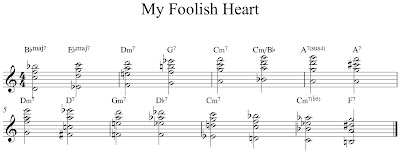

Could this be done with whole or half notes and chords? Could we take a voicing and plane it up in whole or semi-tones, allowing ourselves to alter 1 or 2 notes by a semitone in either direction to compensate for the changing chord functions, all the while moving in a single direction up the fretboard for as long as possible? I think so. Definitely to be done with a bass player.

Monday, October 19, 2009
Ted Meets Mick
I had an idea. I wanted to find out just how much new material working on all these studies had created. How many voicings did they contain which I had honestly never played before and had discovered as I was writing them? Well the answer was actually less than I expected even though it sounds like a lot: 38. The reason this surprised me was because I’d already had almost 30 by the time I was done the first study, the always aptly named All The Things You Are.
If I had generated so little new material while creating all the following studies, why was it that they all felt fresh and as if I was constantly coming up with new voicings? The answer is that I was recycling voicings, but not only in different keys, I was also changing their function. This strange voicing sounds bright on a Cmaj7 in All The Things You Are, but dark on Am(maj7) in Blue In Green.
This shouldn’t surprise me because I wrote and thought a lot about how this is the “green” way to use new material. Yet it wasn’t a point I had consciously set out to illustrate in the studies, however I recognize my following my own advice in hindsight.
So why Ted meets Mick? Well, if you’ve ever opened a Ted Greene book, you’ve been overwhelmed and quickly exhausted by the amount of material within. Nevertheless, something should be said for the systematic layout of the material using chord diagrams, not tabs or sheet music.
If you’ve opened up Mick Goodrick’s Voice-Leading Almanacs, then you also know that the same musical information can be applied and combined in ways with other information which no longer make it sound the same.
Seriously, have you ever tried cataloguing your knowledge? I just did, and I got an answer: 38 (plus probably another 30-40 voicings which I ignore because they’re very basic or I’ve been using them for a long time and know who they came from). It’s kind of liberating.
The Voice-Leading Almanac volume II is called “Don’t Name That Chord.” It deals with clusters and fourths which defy easy tonal categorization. But really, this is a good idea for any and all chord voicings we have. An Em7 is a Cmaj9 is a Am11 is a Dbm7(b9b5). So when I made my charts of all the interesting chords I’ve been experimenting with, I purposefully didn’t give them any names or write down what key I originally used them in or anything like that. All I’ve got is a bunch of ambiguous blobs on an undefined area of fretboard.
Now, my job is to take each of these chords and play with them. Rather than only deciding that a chord is a Cmaj7 and then going through all the songs where Maj7 chords are and using it there, I’m going to try and look at each voicing with an open mind. What could this voicing be? Could it also be a m7b5 voicing? Well, let me see where I can use it in that context. Let me see how I can take 38 and turn it into 380 without ever creating a genuinely new shape or intervallic structure.
However, if I were going to try and find new shapes, I think my next step, following in those of Mick Goodrick, would be to plane any and all of these shapes modally through major and melodic minor.
If I had generated so little new material while creating all the following studies, why was it that they all felt fresh and as if I was constantly coming up with new voicings? The answer is that I was recycling voicings, but not only in different keys, I was also changing their function. This strange voicing sounds bright on a Cmaj7 in All The Things You Are, but dark on Am(maj7) in Blue In Green.
This shouldn’t surprise me because I wrote and thought a lot about how this is the “green” way to use new material. Yet it wasn’t a point I had consciously set out to illustrate in the studies, however I recognize my following my own advice in hindsight.
So why Ted meets Mick? Well, if you’ve ever opened a Ted Greene book, you’ve been overwhelmed and quickly exhausted by the amount of material within. Nevertheless, something should be said for the systematic layout of the material using chord diagrams, not tabs or sheet music.
If you’ve opened up Mick Goodrick’s Voice-Leading Almanacs, then you also know that the same musical information can be applied and combined in ways with other information which no longer make it sound the same.
Seriously, have you ever tried cataloguing your knowledge? I just did, and I got an answer: 38 (plus probably another 30-40 voicings which I ignore because they’re very basic or I’ve been using them for a long time and know who they came from). It’s kind of liberating.
The Voice-Leading Almanac volume II is called “Don’t Name That Chord.” It deals with clusters and fourths which defy easy tonal categorization. But really, this is a good idea for any and all chord voicings we have. An Em7 is a Cmaj9 is a Am11 is a Dbm7(b9b5). So when I made my charts of all the interesting chords I’ve been experimenting with, I purposefully didn’t give them any names or write down what key I originally used them in or anything like that. All I’ve got is a bunch of ambiguous blobs on an undefined area of fretboard.
Now, my job is to take each of these chords and play with them. Rather than only deciding that a chord is a Cmaj7 and then going through all the songs where Maj7 chords are and using it there, I’m going to try and look at each voicing with an open mind. What could this voicing be? Could it also be a m7b5 voicing? Well, let me see where I can use it in that context. Let me see how I can take 38 and turn it into 380 without ever creating a genuinely new shape or intervallic structure.
However, if I were going to try and find new shapes, I think my next step, following in those of Mick Goodrick, would be to plane any and all of these shapes modally through major and melodic minor.
Sunday, October 18, 2009
An Intellectual Framework for Improvising
A student of mine who has been playing guitar for many years before coming to me for lessons has brought to my attention an issue which I have always understood but never consciously acknowledged or had a need to articulate. This is literally how we think about what we’re doing on the guitar. Do we think of our fingers, of the notes, of sounds?
The lowest level of improvisation and musicianship, in my opinion, is finger-focused. In other words, the musician’s relationship with the instrument is very visual, and whether conscious or not, his understanding of what he is doing is very much about shapes. This musician can only play in exact fingerings and executing exact patterns which he has already practiced extensively. This is something we all need to do, so again I stress the word “only”. You can tell who these people are by asking them to play a passage and then repeat the same passage not even in a different area of the guitar, but even with a different fingering. They simply can’t do it. This is because their understanding of their actions is limited to the physical activity they execute with their hands. For them technique is not a means to an ends, but the experience itself of music making.
The next level of improvisation and musicianship, in my opinion, is someone who is conscious of the notes beneath their fingers and their corresponding sounds, but who focuses on technical virtuosity, requiring them to often be stuck in repetitive patterns. Their interaction with music is deeper than the first group of people, but their ability to interact meaningfully with other musicians is limited by their lack of control and ability to both listen and react to others.
The next level of improvisation and musicianship, in my opinion, is someone who can find a genuine balance between static virtuosity and listening/reacting to others in a controlled fashion. The problem with these musicians is that they do not practice enough. This lack of preparation forces them to place an unbalanced amount of concentration on their own actions rather than an equal amount of concentration on their sound as well as the sound of the other people they make music with. Not that they aren’t listening, but they could be listening better if they weren’t struggling to remember what to do as it was happening.
The highest level of improvisation and musicianship, in my opinion, is someone who has the technical freedom to create truly spontaneous music. While I’ve already spent time explaining that we can never create a new scale or chord shape on the fly but only rearrange preexisting patterns, these musicians derive their spontaneity from their ability to respond with a high degree of versatility, sensitivity, and freedom to the actions of the other musicians they play with. Because they are extremely well prepared to play, their reaction time is minimal and they have more awareness as to what other people are playing.
It should be noted that somewhere along the line we all probably oscillate between any and all of these descriptions, perhaps even within the same night or even within the same song.
I would also like to note that I’m fully aware of how subjective, personal and arbitrary this is and how everybody has the right to prescribe their own set of criteria and standards when evaluating a person’s competency.
I would also like to note that my degrees are ranked in order of expressiveness as I see it, with the person not who can play the fastest or anything like that, but the person who is most capable of freely expressing themselves on their instrument at the top. It is not the amount of material we are able to digest or the speed at which we can regurgitate it, but the meaning and emotionality of how it is implemented as well as our consciousness of what everybody else is doing.
I would also like to note that this scale refers to musicianship and improvisation. It would be silly to take what I’m saying out of that context. A singer-songwriter may only play five or six chords, may have no real understanding of harmony or the guitar, but this is not an essential skill for their mode of expression. Simply put, their skill as a musician is a secondary concern. They may not be very good musicians, and they may note have a clue how to improvise, but this is not the means they have chosen to convey their emotions and is an irrelevant criteria for judging their artistic merit.
Finally, I would like to note that among the two “highest” levels their is an ability to think of all the available notes in a scale when creating melodies, and to have the technical freedom to play any notes in any order they can think of and, tempo permitting (the faster the tempo the more linear any new idea will be), have the technical freedom to create spontaneously and play the new melody.
For instance, why practice playing a scale in series of intervals or triads or four note chords or any other pattern (some of which I have spent much time discussing)? Is it to play those patterns at wickedly fast speeds and wow people with your technical virtuosity? Or is it so that no matter where you are on the fretboard, and no matter what finger you are playing whichever note with, if the next note you want is a 4th, 5th, 6th, 7th, or anything else away, your fingers are prepared to play that note with a seemingly instant reflex? Not that there isn’t a time and place for mechanical and “prerecorded” sequences at high velocities. They are useful for creating transitional and exciting material. But is it more (or at the very least equally) about systematically playing through all the possibilities of which music can be made up?
Think of chemical and physical description of the world. The periodic table has 117 elements, but all these elements can be described as combination of protons, neutrons and electrons. And even these protons and neutrons can be broken up into smaller components. So all the known matter and physical events which take place in the universe can be reduced to the interactive relationships between a handful of forces on a handful of particles.
Music can be thought of in a similar light, so to speak. By taking our instruments and practicing musical material on them, not by practicing licks, but by practicing the very building blocks of all music, from serial music to Gregorian chant (intervals), we can react in the most free way possible.
DISCLAIMER: Principles of this article might seem to contradict in spirit the previous article. If spontaneity is an illusion, why then spend so much time talking about levels of spontaneity and the various degrees to which it can be achieved? Well, let’s think about it. If you play every interval possible on a guitar from every note to every other note, than no melody from that point on could ever be considered truly spontaneous because it is made up of tiny elements all of which you have already experienced. Furthermore if you take steps to consciously try not to spew out long and repetitive strings or sequences of these limited number of elements (much like DNA), than you are making fresher music. Certain small patterns of strings constantly reappear (arpeggios for instance) and this cannot be helped, but there are random mutations and variations that can also take place.
The lowest level of improvisation and musicianship, in my opinion, is finger-focused. In other words, the musician’s relationship with the instrument is very visual, and whether conscious or not, his understanding of what he is doing is very much about shapes. This musician can only play in exact fingerings and executing exact patterns which he has already practiced extensively. This is something we all need to do, so again I stress the word “only”. You can tell who these people are by asking them to play a passage and then repeat the same passage not even in a different area of the guitar, but even with a different fingering. They simply can’t do it. This is because their understanding of their actions is limited to the physical activity they execute with their hands. For them technique is not a means to an ends, but the experience itself of music making.
The next level of improvisation and musicianship, in my opinion, is someone who is conscious of the notes beneath their fingers and their corresponding sounds, but who focuses on technical virtuosity, requiring them to often be stuck in repetitive patterns. Their interaction with music is deeper than the first group of people, but their ability to interact meaningfully with other musicians is limited by their lack of control and ability to both listen and react to others.
The next level of improvisation and musicianship, in my opinion, is someone who can find a genuine balance between static virtuosity and listening/reacting to others in a controlled fashion. The problem with these musicians is that they do not practice enough. This lack of preparation forces them to place an unbalanced amount of concentration on their own actions rather than an equal amount of concentration on their sound as well as the sound of the other people they make music with. Not that they aren’t listening, but they could be listening better if they weren’t struggling to remember what to do as it was happening.
The highest level of improvisation and musicianship, in my opinion, is someone who has the technical freedom to create truly spontaneous music. While I’ve already spent time explaining that we can never create a new scale or chord shape on the fly but only rearrange preexisting patterns, these musicians derive their spontaneity from their ability to respond with a high degree of versatility, sensitivity, and freedom to the actions of the other musicians they play with. Because they are extremely well prepared to play, their reaction time is minimal and they have more awareness as to what other people are playing.
It should be noted that somewhere along the line we all probably oscillate between any and all of these descriptions, perhaps even within the same night or even within the same song.
I would also like to note that I’m fully aware of how subjective, personal and arbitrary this is and how everybody has the right to prescribe their own set of criteria and standards when evaluating a person’s competency.
I would also like to note that my degrees are ranked in order of expressiveness as I see it, with the person not who can play the fastest or anything like that, but the person who is most capable of freely expressing themselves on their instrument at the top. It is not the amount of material we are able to digest or the speed at which we can regurgitate it, but the meaning and emotionality of how it is implemented as well as our consciousness of what everybody else is doing.
I would also like to note that this scale refers to musicianship and improvisation. It would be silly to take what I’m saying out of that context. A singer-songwriter may only play five or six chords, may have no real understanding of harmony or the guitar, but this is not an essential skill for their mode of expression. Simply put, their skill as a musician is a secondary concern. They may not be very good musicians, and they may note have a clue how to improvise, but this is not the means they have chosen to convey their emotions and is an irrelevant criteria for judging their artistic merit.
Finally, I would like to note that among the two “highest” levels their is an ability to think of all the available notes in a scale when creating melodies, and to have the technical freedom to play any notes in any order they can think of and, tempo permitting (the faster the tempo the more linear any new idea will be), have the technical freedom to create spontaneously and play the new melody.
For instance, why practice playing a scale in series of intervals or triads or four note chords or any other pattern (some of which I have spent much time discussing)? Is it to play those patterns at wickedly fast speeds and wow people with your technical virtuosity? Or is it so that no matter where you are on the fretboard, and no matter what finger you are playing whichever note with, if the next note you want is a 4th, 5th, 6th, 7th, or anything else away, your fingers are prepared to play that note with a seemingly instant reflex? Not that there isn’t a time and place for mechanical and “prerecorded” sequences at high velocities. They are useful for creating transitional and exciting material. But is it more (or at the very least equally) about systematically playing through all the possibilities of which music can be made up?
Think of chemical and physical description of the world. The periodic table has 117 elements, but all these elements can be described as combination of protons, neutrons and electrons. And even these protons and neutrons can be broken up into smaller components. So all the known matter and physical events which take place in the universe can be reduced to the interactive relationships between a handful of forces on a handful of particles.
Music can be thought of in a similar light, so to speak. By taking our instruments and practicing musical material on them, not by practicing licks, but by practicing the very building blocks of all music, from serial music to Gregorian chant (intervals), we can react in the most free way possible.
DISCLAIMER: Principles of this article might seem to contradict in spirit the previous article. If spontaneity is an illusion, why then spend so much time talking about levels of spontaneity and the various degrees to which it can be achieved? Well, let’s think about it. If you play every interval possible on a guitar from every note to every other note, than no melody from that point on could ever be considered truly spontaneous because it is made up of tiny elements all of which you have already experienced. Furthermore if you take steps to consciously try not to spew out long and repetitive strings or sequences of these limited number of elements (much like DNA), than you are making fresher music. Certain small patterns of strings constantly reappear (arpeggios for instance) and this cannot be helped, but there are random mutations and variations that can also take place.
Subscribe to:
Posts (Atom)