Wednesday, December 16, 2009

Fun Clusters With Open Strings


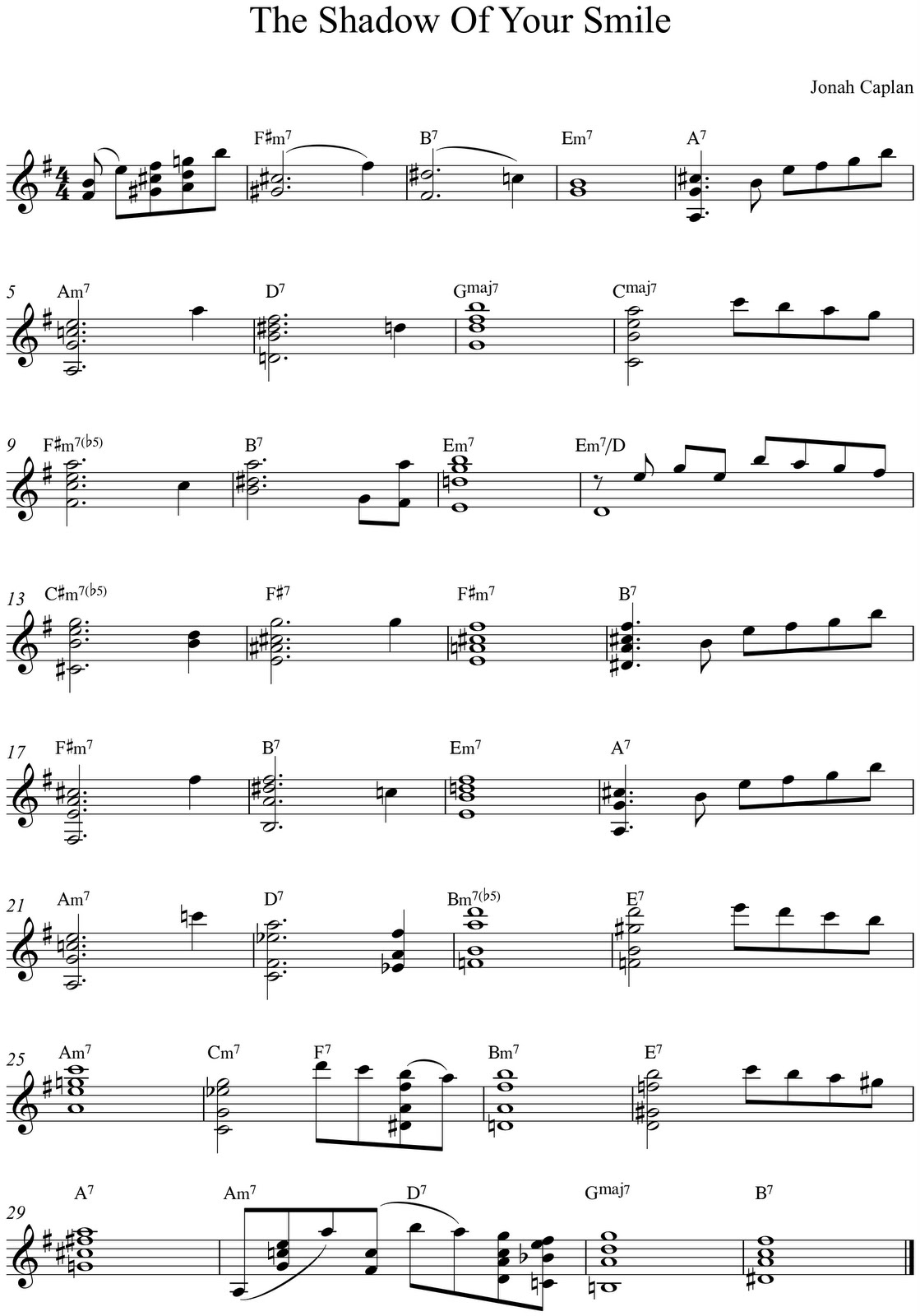
The 5th bar is the most interesting shape to try and find a picking pattern for because there are two separate sets of strings where the note on the higher string is the lower sounding one.

Monday, December 14, 2009

The Song Remains The Same/The Return Of The Almighty Triad/Wish You Were Here

Once we’re on the topic of teaching, I’d like to point out something that should seem obvious yet also seems to not be reflected in much of jazz education. I’d also like to note right away that this ties into the free jazz conversation dating back to my first blog entry and much thanks to my free jazz guru, Mitch Haupers. The skill of improvisation and listening is a skill which is distinct and separate from the acquisition of a musical vocabulary. But when we improvise, you ask quite rightly, don’t we use a vocabulary? How can you possibly mean that? Well, improvising means to me having a message and a distinct logic in the way ideas are put together in a sequence. In a way this article is not so different from improvisation. I know where I want to be at the end and I know where I’m starting but I have not mapped out how I will proceed in the middle. Yet inside I can feel intuitively that all the points are there and that I can have this discussion logically. Now, I could write this article in French or Italian or Chinese or Hindu or any other language (if I actually knew any of them well enough) but the content would remain the same and my methodology in the way I go about creating my story, my point, my thought process, would also remain the same.

With that said, I find it strange that most beginning jazz students are introduced to the art of improvisation at the same time they are introduced to the vocabulary of jazz, which happens to be more complicated than some other available vocabularies. As I mentioned in my last article, I discuss with student’s in the context of simple songs, triadic in nature with slow moving harmonic progressions, or even pedals, how to create a complex interaction between the different components of music (i.e. using multiple skills at the same time). This might mean playing a continuous melody which involves two or three closed positions and transitioning between them using the skill of playing on one string. This might involve working triadic arpeggios or chordal gestures into our melodic playing or embellishing triads using the knowledge we have acquired through the playing on one string or in closed position. This whole idea of synthesizing concepts which were originally introduced as separate and unrelated lies at the heart of improvisation, in my opinion. If a young student can master complex ideas with a simple vocabulary, to extend these ideas to a more complicated vocabulary will come much more naturally to them. Why are they trying to solo using fourths or chord substitutions or drop 2 voicings if they can’t even solo using triads?

The study that follows serves two purposes for two different skill levels. The first group is the maturing student who I was just describing. They will be pushed to analyze the piece and name all the notes on the neck of the guitar and in doing so they will build stronger fundamentals and have an easier time playing closed positions triads. Although they probably will never play open triads anytime soon, it will be a good exercise to help them with their closed triads. For this reason, tabs have been included.

Oh, I forgot. This exercise is about open triads. A sound which I find very interesting and particularly beautiful on the lower five strings of the guitar. I have already spent much time exploring the possibilities of triads in this blog as either vehicles for melodic inventions or chord substitutions. Perhaps in working on open triads I might unlock new possibilities in both these areas. And just like my students, I think it would be good to start with something simple just to get started. Naturally, since this exercise is much less mind-blowing for an advanced jazz musician than a young and inexperienced rock musician, it should be transposed into all twelve keys.


Friday, December 11, 2009

The Big Jug and the Little Jug

I like to bombard students with more information than they could ever possibly absorb in the amount of time I say it in. Furthermore, I sum up numerous concepts in an hour and tell them to get them done even though these ideas probably took me years to learn in any kind of meaningful and practical way. I give them a completely impossible task knowing that they are going to fail. Why would I do such a thing? Am I sadistic? Do I like destroying the confidence of children?

Contrary to what some might say, the answer would be no to all those questions. There are a couple of reasons for teaching this way.

The first and most important principle is that a teacher’s job should be to help a student find their voice and understand that this is going to differ from their own voice. With that said, one way to help a student make the decisions which will shape their personality and playing style is to over-inform them. What they are forced to do is to edit the information you provide them and choose to focus on what is important to them and what resonates with them. If I tell a student to work on four things knowing they will only work on one or two of them very well, what I learn the next week is which thing is of the most interest to them and this helps me focus on what they need. They’ve made a selection without being conscious of the fact that they were offered a choice. The student thinks that they have failed to complete all their tasks but that was never the point. The question was not whether they would succeed but how they would choose to fail.

This is the first level of over-information. Once we have discovered and begun to pursue a specific thread in the student's development and found something specific to work on for a given period of time (perhaps two to three weeks of intense focus, always good to change the subject within a month), the next level of over-information begins.

Here’s an example. I might telling the student to work on playing scales in five keys horizontally on a single string, to practice all seven modes in closed position, to work on combining triads with the pentatonic scale to develop cool rhythmic gestures, and to be able to improvise competently on a simple progression (think Wish You Here Here) using all these techniques and combining and interchanging them fluidly. In a week. Even though I know that what I’m asking for is simply not something that happens in a week. But what are they going to do that week and when they come back what will they be playing? What will have been worked more on? What will have been overlooked or considered to be a dead-end? Where did they see the possibilities? And from there we can then dive into the topic of their (unconscious) choice in greater detail and begin the process of over-stimulation again. Suppose they seem to be interested in single string scales. Not only should you do five keys, but practice playing thirds and sixths on all available combinations of strings trying to understand them as either harmonic progressions or as doing the one string exercise but on two strings at the same time. Once you can feel their creativity turning stale and their interest beginning to wane over the following weeks you can slowly pull their focus back to a more global perspective of all the different areas, and then bombard them with the same assignment again and see what they come up with the next time. Maybe they will be interested in triads. Come up with some unbelievably ridiculous task involving triads to be completed in a week and see what they do. This allows them to mould their own voice. You simply point them in a direction and see if they walk there. If they decide to walk somewhere else that is also fine. Whether they choose to follow or not, they are reacting to your guidance and you have positively affected them.

Name a subject and there will be a million things to try, a million different exercises to work, too much for any human being to do. There is always a next level within each little tiny nook of technique and then there is the combination of all techniques which is itself a never ending technique. So we have to choose. Allow the student to make the choices for themselves. Present them with options.

Mick Goodrick talks about the Chinese food menu approach to practicing. Write down all the different things you can work on and then every day pick out an item or two (like ordering from a menu). The menu of practicing and the menu of music period is endless and infinite. You could eat the same meal every day or try something new every day or build up a network of dishes you like and maybe try a different one when you’re feeling adventurous. That’s gone far enough and you get the point. Present students with a menu of their own and allow them to pick their own dishes. Don’t be like an obnoxious parent and tell them what to order.

Finally, we get to the jugs. We have a big jug in the back of our heads and a small jug in front. You, as a teacher, are holding the jug in the back of your brain, which, having more experience, is much fuller than the jug in the back of your student’s brain. Every lesson you pour your entire jug over your student and they catch whatever they can in their small jug. The small jug passes this on to the big jug, and probably spills some stuff along the way. The next lesson you return and poor the whole jug over the student and again they catch what they can in the smaller jug. And again they transfer to the larger jug, which is very slowly getting fuller and again they lose some water along the way. This is the transfer of knowledge.

Even when we teach ourselves, we have to understand this about our capacity to understand. We run to the well of knowledge and become greedy for information. We sometimes ignore the fact that our little jugs are full and continue to poor water into it, watching it overflow but desperately refusing to admit it. We need to stop and allow the little jug to carry itself back to the big jug. We are only wasting our energy. We all know what it feels like to reach the point in our practice when we have gone too long and start to get worse instead of better. We must respect the process of learning, of deep learning, and understand that our little jugs are only so big, not to become too concerned with filling our big jugs. Because there is simply no rushing this process.

So failure is a beautiful and necessary part of learning. As we acquire skills, we must understand that what we seek to learn is most probably massively huge and could never fit in our small jugs. So we must be patient in the way that we practice and adjust our expectations about our results. We must recognize that some things cannot be learned in a single session, that they are a process which takes time and therefore are pointless to rush. And we must embrace failure as an important part of transmitting information because the best way to help a student flourish involves designing tasks for them which they absolutely cannot complete. We must accept and enjoy their failures with mutually felt humour and lightheartedness. The point is exactly not to get things right the first time. The point is to fill up one jug at a time and not be afraid to spill a bit.


Monday, November 16, 2009

Dynamic Duo

I was recently playing guitar with my friend Aaron Schwarz and we wound up having quite a lengthy discussion about the importance of dynamics and accents in making music beautiful. Open any score dated from the 18th century onward, and we find dynamic markings, slurs and accents amongst other things which help us understand that performance is so much more than just playing notes, and also what the composer’s vision of how all these various other factors should be handled.

Two interesting articles on the subject include http://www.kylegann.com/notation.html, which talks about the dangers of over notation, as well as http://thebadplus.typepad.com/dothemath/2009/09/interview-with-keith-jarrett.html, an interview where Keith Jarrett talks a lot about touch, about a lack of sensitivity amongst jazz pianists and I would like to extend his point to many jazz guitarists.

Horn players spend their formative years learning proper technique and reading music with a focus on how to play and phrase and feel it accurately. Most guitarists probably learned music other than jazz and in some combination of reading magazines or books and piecing things together by ear. When we are introduced to jazz, we are presented with lead sheets, sparse papers with little information on them other than the most essential to get a musician started on the process of interpretation. It is still necessary to listen to performances of the song, understand all the harmonic nuance that every good jazz musician brings to a tune, that the changes as they are written are a starting point and should never be considered a destination and that any good group contains both a rhythm section and soloists who are open and flexible enough to go places other than the typical.

 Back to the point, guitarists encounter a written form of jazz which does very little justice to the actual performance of jazz. There is so much nuance in any good jazz musician’s tone and use of dynamics, their touch on their instrument, and yet so little time is devoted to developing this consciously with students of jazz. You got it or not, I suppose. Actually, I don’t suppose that at all.

When I started taking guitar lessons formally in school, my wonderful teacher Nick Ditomaso never failed to amaze me week after week. It seemed like there were a million things he knew how to do and I just didn’t have a clue what any of them where. This changed about halfway through our association. Over a year and a half I’d worked furiously to learn all the scales and how to improvise and comp using drop 2 chords and a generally more melodic approach to rhythm playing. As my second year came to a close, I’d succeeded in doing this to some degree. I’d even figured out a couple of voicings that seemed to be all mine. But I still didn’t sound half as good as Nick did.

Now I began to become truly awestruck in a much deeper sense by Nick’s sound. I couldn’t understand how he sounded so amazing and I didn’t. When I watched his hand move, I could finally recognized the voicings and patterns. I’d learned a decent chunk of the standard jazz vocabulary on my instrument (in terms of scales and voicings), and like any other guitarist playing standards, Nick was often referring to this vocabulary in his playing in ways that I could comprehend. But still his sound was lightyears ahead of mine and I didn’t really get why.

Over the next year and a half, I began to bridge the gap in our sounds but never consciously and only very minutely. Nick always told me to work more on my tone but I always felt like what he was really asking me to do was buy a new guitar and that wasn’t going to happen. I wasn’t ready to understand what I was missing because I was still too focused on vocabulary. I was fascinated with the idea of altering chords, of playing outside, using chromatic passages, learning tunes and finding voicings which allowed me to play the harmony and melody at the same time. I loved Lenny Breau and Ted Greene but no matter what chords I learned I could never even begin to approach their sound. As I got my hands on all the material I could about them and by them, I was again, much like with Nick, chronically disappointed by the lack of a secret chord or two which would let me sound like them.

Then I met Mick Goodrick. Mick talked very little about touch. But he played in front of me every day for five days and in just sitting and listening to him over the course of a week it hit me. Watching him play, hearing him attack, hearing his careful attention to dynamics and his quiet authority had a big influence on me. When I met him for my lesson I was determined not to try to impress him by overplaying. How many people walk into a room with Mick Goodrick and whip out their best licks in the first chorus of their first solo and accomplish nothing musically and tell no story whatsoever? We played Stella By Starlight and I came in very quietly and delicately. I tried to be melodic, didn’t worry about conveying to Mick that I knew the changes and could play over them. I wanted to build something because I thought that would be more impressive and so accordingly I wasn’t in a rush. Along came my second chorus and I started to lay into the notes a bit more. This is the first time in my life playing jazz that I can remember where I consciously used dynamics as a major factor in the building of my solo. But I went too far too fast. It was too loud for Mick. I’d spoiled our sound with a lack of sensitivity and he stopped me and told me so.

The same day I played a free jazz piece with 3 other guitarists, and 2 very talented and wise musicians named Vardan Ovsepian on piano and Bob Weiner on drums. Minutes into the piece, it still felt like it wasn’t building to me, like the other guitarists were holding back too much or too scared to play with commitment so I took it, quite arrogantly and mistakenly, upon myself to push things in a certain direction. Quite naturally, I once again got very loud very fast. What resulted wasn’t so bad, but it was basically musical premature ejaculation. Things boiled up very fast and cooled off almost instantly after hitting a peak. It was a noisy experience. And I experienced a sensation of extreme heat while playing which left me overwhelmed and flustered and actually drove me to tears a bit later in the day.

To say I came home and went wild about dynamics would be a lie. My first blog entry was a summary of everything I’d taken away from my week with the Mr. Goodchord team and there is no mention of dynamics in that article, nor did I mention either of those very important stories. I was overwhelmed by these events and I wasn’t ready to face them yet. But they were a part of me and they were guiding me. I was scarred and quite unconsciously the way I heard myself began to evolve. When I finally recorded myself almost 5 months later (you can hear that recording of Stella on MySpace), I was pleased to finally hear what I’d been searching for without knowing it for four years: dynamic nuance. Even my most stock phrases, things I’d been playing for most of those four years, suddenly were popping out at me. They had become three dimensional. My foot was in the door.

Can we work on these things consciously? Can we build exercises to help us develop the physical skill of having many different and interchangeable levels of attack?
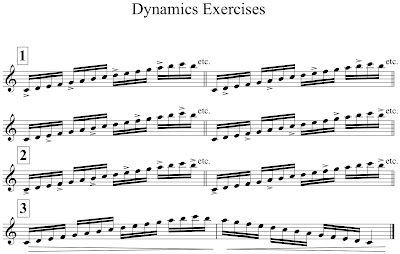
Here are a few:

Take any ii-V lick and try playing it at a single tempo and see how many different volume levels you can achieve. Try this at different tempos and see which volumes are difficult. The faster you get, the more obviously hard it becomes to play quietly.

Another thing to do is to play a scale up and down at various tempos, placing the accent on a different 16th note every time (1). Also, this can be done with 3 and 5 which displaces the accent (2).

Also, as we get higher we have a tendency to get louder and play harder and there’s something inherently more relaxing and gravitational about playing a descending scale. So try playing a scale getting quieter going up and louder going down (3).


This conversation does not only apply to playing single notes with a pick. Using your fingers to play chord solo types of sounds is infinitely more effective in terms of dynamics as well. I think my studies are actually very good for this exercise. If you see the videos, you’ll notice that I arpeggiate the chords, perhaps add in melodic embellishments, but that none of this was notated. Playing the studies is firstly a very note oriented exercise in learning new and wider voicings. But unconsciously, I was also working on popping out the melody from the overall texture of the rest of the chord, by creating dynamic contrast between the most important note at any given time and all the others (it's hard to tell since the audio quality is so garbage). These studies are good for that because the wide voicings tend to make the melody notes sound more isolated, which can help you start to hear things differently. I think they did that for me.

Sunday, November 15, 2009

The Beethoven Blessing

If you ask most people to choose between having to be deaf or blind they quickly choose deafness. Since my ears are my most important and only constant instrument regardless of what kind of music I am doing, I quickly choose to go blind rather than lose such a critical tool for my art.

Beethoven started going deaf around the age of 30. In his wikipedia article it states that “Over time, his hearing loss became profound: there is a well-attested story that, at the end of the premiere of his Ninth Symphony, he had to be turned around to see the tumultuous applause of the audience; hearing nothing, he began to weep.” Beethoven’s last and unsuccessful attempt at performing his own work was in 1811, sixteen years before his death. So how did a man so profoundly deaf continue to compose new and influential pieces of music for 16 years, especially his ninth symphony and and the late string quartets?


Well, go back to his very first string quartets and you’ll find the exact same harmonic language. In fact, check out his symphonies or piano sonatas, everywhere the same chords follow the same sequences. So what was on Beethoven’s mind?

I would like to hypothesize: everything else. Notes are the most insignificant aspect of music. You either follow the principles and standards of a style or not, and therefore sound one way or another. This takes time to understand and be able to employ, certainly if you have an interest in numerous styles all with different aesthetic principles (or lack thereof) as well as general attitudes and emotional demands. Although it may take years to reach an adequate level of proficiency in simply being able to use the musical vocabulary of a style accurately, this is the first and least important step in the process of making beautiful music.

Once you’ve got your notes in order, it’s time to move on to all the other aspects of composition and improvisation such as dynamics, phrasing, form, motivic relations, etc. that make great music what it is.

So how did Beethoven’s music evolve over his career? Well, I recently read quite a few chunks of a book called “Inside Beethoven's quartets: history, interpretation, performance” by Lewis Lockwood and the Juilliard String Quartet. It helped me understand what was so amazing about Beethoven as well as how he became increasingly sophisticated over time. It had nothing to do with harmonic inventions. Beethoven was an architect. How bits of musical information interacted, how he played with form and structure, with dynamics and pacing, was what made him a master.

So why blessing? Well, for starters, check out Christos Hatzis’ essay called “The Crucible of Contemporary Music.” One thing he talks about is that when we start out as artists, we are, in all honestly, just following an egotistical desire for attention and affection. Over time, if you’re lucky, this urge to create can grow into something more mature, more mystical, and less self-centered.

So why the Beethoven Blessing? Beethoven understood better than any other composer had until that time that we would turn him into something he wasn’t: a caricature and a god. He was the first composer to take very seriously the idea that he was writing music for people who he would never meet, perhaps for off into the future. When people reacted negatively to his middle or late quartets, he responded that they were written for the future, for others who would be able to understand them better (I’d love to be more specific but I returned the book over a month ago and don’t feel like doing the research, but this fact is based on an anecdote told by Lewis Lockwood who is a serious Beethoven scholar). Beethoven had an ego. A big ego. You need one to do what he did. You have to believe yourself capable of great things before you stand a chance at doing them. It’s a struggle not to let that get to your head.

Although Beethoven’s deafness brought him great suffering and made him suicidal, in a way it was a blessing because it forced him to limit his artistic vision to a very specific set of criteria. If he had never gone deaf he might have simply tried to do too much, even with all his colossal talent. If he had never gone deaf, we would never have all the beautiful works that he could not have written unless he had gone deaf. And he might have spent too much time anticipating much of the harmonic innovations which would be developed over the following century and as a result not succeeded in being the pinnacle of structural genius of Western music.

Furthermore, Beethoven’s deafness is a blessing to the rest of us, because it teaches us how much goes into the art of composition and interpretation that is completely outside the mere selection of notes.

One afterthought while we’re on Beethoven, a post-script so to speak, is that I don’t agree with the notion of writing for the future. Music is about connecting to an audience. A live audience. Not necessarily a large audience. Not even necessarily an audience at all, just the simple sharing of music amongst musicians creating a moment together is a beautiful thing. Compositional tools which have no impact on a listener are completely unnecessary from the perspective of creating for an audience. That isn’t to say they must be completely abandoned. If they don’t detract from the piece of music emotionally at all, and they bring the composer satisfaction, no harm done. But if the composer’s intellectual satisfaction comes at the expense of the listener’s emotional satisfaction, than in a very real way the composition is a failure. I bring this up because, sometimes Beethoven is simply too long for me. I was surprised to find after listening to the quartet Op. 130 that not only was it extremely long, but it was long even though the Alban Berg quartet had actually left out many repeats in their performance. Of course, if a piece is written for musicians to perform simply for their own enjoyment in private, then the composer has met the goal of satisfying his audience and has succeeded even if most people won’t like it. Still it’s funny how so many jazz musician’s and classical composers resent the fact that their music is not appreciated by a wider audience yet they make no effort to accommodate and compromise with this audience. Every relationship is a two way street.